NIMBY Rails: Global, data-driven rail sandbox and scheduling simulation tool
NIMBY Rails by Weird and Wry is a Windows rail management simulation that lets players design and operate networks across real-world geography. The app centers on track building, rolling stock selection, and timetable management to move individual passengers and run a viable service. It pairs detailed editing systems with sandbox play and planner-style goals. The game targets hardcore simulation fans, transit hobbyists, and map-oriented players who prefer open-ended infrastructure challenges.
The app maps the entire planet at 1:1 scale
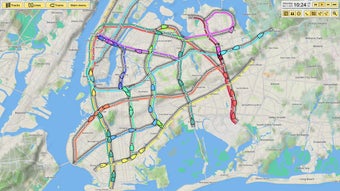
In this game, your canvas is the real world, supplied from OpenStreetMap so you can route lines without tile borders. The continuous, global map supports projects that span cities, regions, or entire continents; examples include long-distance corridors and local urban subways. Track geometry emphasizes precision; the editor supports multiple rail types and fine control over curvature and gradients, making location and terrain meaningful design constraints.
Cooperative play and community content broaden long-term projects
When you play with others, cooperative real-time multiplayer lets several builders work on a single network simultaneously, and Workshop integration enables community-created assets. Those features support collaborative experiments and shared servers where teams test schedules and equipment together. Custom models and track variants from the community expand visual and operational variety beyond the base install, which suits players who like joint problem-solving or mod-driven variety.
Operational depth forces timetable and demand thinking
Here the simulation treats passengers as individuals with specific origins and destinations, and demand responds to population density and time zones. Timetabling, fare setting, loans, and accounting create feedback between service choices and solvency. Precision in signals, gradients, and rolling stock selection affects on-time performance, so planning is not purely cosmetic; running a network requires juggling schedules, vehicle assignments, and financial constraints to keep flows moving.
Accessible systems come with hardware and onboarding expectations
While assembling networks, the app expects a modern Windows desktop: it requires at least 8 GB of RAM, a DirectX 11 compatible GPU, and benefits from multi-core processors for large simulations. The interface exposes professional-grade controls that reward careful use but also lengthen initial setup time. The experience is primarily sandbox-driven rather than campaign-based, so players must set their own goals and learn systems without guided missions.
Recommended for dedicated planners and modders
The app is a focused choice for methodical transit designers and map enthusiasts who enjoy long-term, data-centered projects. However, community feedback highlights a steep learning curve and an absence of a traditional campaign, so newcomers seeking guided progression may prefer a different sim. Players prepared to invest time will find a sandbox that supports ambitious experiments and operationally rich challenges.